Saturday, October 6, 2007

Virutal Worlds 2007

If you happen to be in the virtual worlds business, you shouldn't miss next week's Virtual Worlds conference which is taking place in San Jose.

As you probably know the virtual worlds arena is "exploding" these days and alongside the growth and acceptance of online worlds such as Second Life, Habbo Hotel and more, there is room for mobile solutions - whether in the form of simple SMS services for virtual worlds (And there are a lot of those already in Second Life) or in the form of a complete virtual mobile world, and everything in between.

So if you're interested about the fusion of Mobile and Virtual worlds, the conference is certainly going to be a good place to explore it, as it features speakers from key players in the industry, some already doing several things in the area.

For example, Sulake's Mini Friday is an interesting mobile virtual world. It started as an experiment, as Sulake defined it, but crossed the 100,000 registered users last month, after less than a year of activity (And a rather narrow support base for various handsets).

There are several senior speakers from Sulake as well as from other mobile companies such as MoiPal, and it's also interesting to hear what do the companies that still don't have any mobile solution plan in the near future.

You can find the full list of speakers and sessions in the conference site. See you there!

Monday, October 1, 2007

Mobile 2.0 - The conference

In about two weeks, Mobile Monday together with the Open Group is organizing in San Francisco a One-Day Event Focusing on the Mobile Web and Disruptive Mobile Innovation.

The event brings together experts and thought leaders from all aspects of the mobile ecosystem, including investors, mobile carriers, device manufacturers, and mobile application developers and web technologists.

Among the topics to be covered are: User Experience, Usability, and Design, Emerging Technologies, Enabling Infrastructure and Convergence, Disruptive Business Models and more.

This is the second year this event is being held, and the previous one was highly recommended by the people who participated.

As you probably know, Mobile Monday is a global community of mobile industry professionals with chapters across the world, that typically have meetings once a month (on Mondays...). Since I am going on business to the bay area in October I was searching for a Mobile Monday meeting of the silicon valley chapter, and was (positively) surprised to find out that this month's meeting is actually the Mobile 2.0 conference (which is organized together with other chapters such as the London chapter).

This is truly a once in a year opportunity to meet with all the right people from the industry in a more intimate atmosphere (as compared to the crowded 3GSM or CTIA, which is also around the corner).

So, if you happen to be in the bay area, you should certainly drop by (and even if you're not scheduled to be there - you just found an good reason...). So go to the event site and register (If you're super fast you may still get the early bird discount...)

See you there!

Wednesday, September 19, 2007

The office move craze

Over the past week we have been busy here at GamearraY with our office moved. We actually just moved between floors in the same building, but still it's quite an effort...

Suddenly you have to take care of things that were always there and were taken for granted (Didn't I use to have a desk?...), but as people say, as long as the wireless Internet connection moved with us all else is negligible (who needs water anyway...).

Anyway, In the end I think it went quite smooth especially thanks to our administrative assistant. But I (as well as several other employees) have been rather busy with all the involved logistics whether we wanted to or not...

There are still some things to do and stuff to find before we will be fully settled, but the new office is bigger than our last one and very comfortable so it's all worth it (And we need the space since we are expanding these days).

And of course aside from all the logistics we still have jobs to do... so my day is very full, but once everything streamlines, which should happen soon, I am going to resume writing on mobile content and also introduce you to some of the new writers we have now on board. Stay tuned!


P.S. - The picture above is my room in our previous office after all the stuff there were moved...

Wednesday, September 12, 2007

Shana Tova!

It is the new year's eve here in Israel. For those of you taking a look at your calendar, don't be alarmed - it's just September now, but according to the Jewish calendar, today is "Rosh Hashanah" which is the Jewish new year.

By the way, I took a look at Wikipedia, and saw that in fact you can celebrate the new year just about anytime you want, since there are so many different new year holdays celebrated by various religions and nations.

Anyway, I just wanted to say "Shana Tova" (the equivalent of happy new year) to all of NextGenMoCo's readers, may we all be successful both in our personal and professional lives.

P.S. - Last Sunday I have been at the "Jerusalem Rocks" festival here in Israel, and saw an amazing concert by the Black Eyed Peas and Arrested Development. I think it's the best show I've seen in years, they gave all they got. Thanks to Jeff Pulver and his friends for organizing this show. If you want to catch some pictures from the concert, check these.

Wednesday, August 29, 2007

What the future holds for mobile music

About two weeks ago, the Compact Disc celebrated its 25th birthday. It's amazing to see how things have changed since. What considered to be a revolutionary technology in the 80s, and was made mainstream in the 90s is already fading away...

Many factors caused the descent of the CD, but the major one was the MP3 format which came out in the mid 90s and became popular with the penetration of ADSL into households all over the world (And of course with the advancements of hardware such as larger storage devices that allow users to maintain huge libraries of music and faster CPUs that can actually play MP3s and allow the user to do other things as well...).

In addition, the ease of distribution (both for the vendors and the users) is simply a huge leap from the CD era: You hear a song that you want? You don't have to go to the nearest CD store (which are quite empty nowadays...), you just go to iTunes or another vendor and download the song. Also, the track is available on your computer or MP3 player, and you don't have to change CDs etc - we don't even think of these things today, which is a great sign of technology acceptance.

What does it all have to do with mobile? Well, I believe that mobile technologies will play (and already are playing) a big part in the next evolution of digital music. People (and especially teenagers and young adults) like their music to go with them. Music is one application which is in sync with the handset capabilities and form factor.

Unlike games & videos - bigger is not better: You don't have to have a big screen or other hardware that is not in sync with the essence of a mobile phone: You can output music in great quality via the headphones, and have a lot of storage with a memory card (Today 4GB cards are not rare, and it will only grow).

And since people don't like carrying a lot of stuff, but they won't go anywhere without their mobile phone - The MP3 player as a standalone device is short-lived, and will be assimilating in mobile phones (And this is already happening).

And the great thing about an MP3-player inside the handset as opposed to a standalone device, is music distribution: The handset can connect to the Internet and download songs. This is a huge advantage: If you are on the go, and want to hear a song you don't have/own, you can download it - and this is the real deal: Even after MP3s were widely used, you still needed to pre-download your selected music to the MP3-Player (Or a few year before that make a mix-CD with your CD burner) - Now you can not only hear music on the go, you can also get music on the go (And there's an Israeli startup called Hingi that allows users to download songs they just heard in the radio/TV even if they don't know the name of the artist/song).

Even Apple, maker of iPod, the most popular MP3-Player is foreseeing this trend and therefore invested a lot of resources in the iPhone. The ultimate MP3-player cannot stay disconnected - it has to be able to give the user the whole experience.

Of course there's the issue of piracy, which is bothering everyone in the music industry (After they had a few relaxed years when the CD came out, and before CD-burners were widely available...), but frankly, the mobile can handle DRM issues even better than the PC (And still I foresee a different business model for music consumption in the near future).

BTW - ADSL also pushed out the CD as a dominant way of distributing software: It is easier to distribute software over the Internet without any need for physical media, and sizes of hundreds of MB can be downloaded easily and faster than ever.

P.S. - As you probably noticed I haven't written here a lot lately, and this in part due to preperations for my 30th birthday which was yesterday... I just hope not to be outdated as the CD...

Monday, August 13, 2007

Summer time (And the gPhone)

August is here and the sun is high in the sky, and though I myself am not on vacation (a lot of interesting things are happening these days in GamearraY), a lot of lucky people are...

And this is why I decided to postpone the publishing of articles I received in the last couple of months. As you remember (or not) this blog will soon feature posts written by others and not just myself (And if you are a mobile specialist you're also more than welcome to join the team).

I have already collected some articles from various mobile industry professionals and we have interesting pieces about mobile advertising, media, messaging, video and more. Since I don't want these posts to go up unnoticed (due to summer time) I am planning to publish them on September.

In the meantime (if I am already writing this post...) I should mention the gPhone or Google Phone or whatever you want to call it... There have been some rumors about it and they are now getting stronger... you can read about it in Mashable! (Which is a great web 2.0 blog if you don't know it yet).

Friday, August 3, 2007

Jerusalem Rocks!

Today a lighter subject for a change... In about a month (On September 9th) an international music event will be held at Teddy Stadium in Jerusalem. For those of you who don't know yet - the Black Eyed Peas are coming to Israel and will be the main performer in the Jerusalem Rocks music festival.

They will be accompanied by Arrested Development (The rapper, not the great TV show...) and The Commitments (Yes, the band from the movie). This is certainly one of the biggest music events seen here recently, and it is definitely a great finale to this summer that featured a lot of international artists on their first appearances in Israel.

But unlike the other events, I think this is the only major event taking place in Jerusalem (and not in the Tel-Aviv area), and that's no coincidence... The organizers of the event want to make a statement to the world (and maybe even more importantly to Israelis...) that Jerusalem is a vibrant city and a great place to culture, business and most of all - peace (You can read the whole mission/vision here).

And speaking of the organizers, some of them are not from the music industry but rather from the hitech industry... These include among the rest Jeff Pulver, founder of pulver.com and a VoIP expert and Jacob Ner-David who runs a VC in Jerusalem right next to GamearraY's offices (and close to Teddy Stadium, so I guess we'll both be walking to the event by foot...). The producer of the event is Carmi Wurtman, who produced The One Shekel Festival (hebrew), and (what a small world) - his brother Elie (now with Benchmark) invested in GamearraY when he was with JVP...

So, if you didn't have a good reason to come to Jerusalem so far, here's your chance... See you there.

Wednesday, July 25, 2007

Porting 101 or How to destroy an industry...

One of the mobile market's major problems is the porting issue. Everyone in the industry is aware of the grim fact that every mobile application you make, you have to port to hundreds of mobile phones. The porting efforts can sometimes exceed the R&D time for the entire application... This issue holds the whole industry back, and must be resolved to get the mobile industry to the next phase.

I wanted to write about this subject for a long time, but it is so elaborate that every time I tried to, more and more issues popped into my mind... So I decided to "just write it", knowing that I may have missed a few things, but I would like to dig a bit deeper into the roots of the problems, as the effects of it are already known...

Unlike PCs, mobile phones are very different from one another. It begins with a different hardware (screen, memory, multimedia capabilities) and ends with a different OS/Virtual Machine.

One of the major differences between phone is what OS/VM they support. Some support Sun's Java (J2ME), others Qualcomm's Brew, others support Symbian and then there's the Windows CE smartphones and the Linux-based phones etc.

Going from one of the platforms listed above to the others, is more than porting - it is actually rewriting the application (And managing several codebases afterwards), and if all of the above would have had equal market shares - we might have been in a bigger problem than we already are... However, Luckily for us there is one platform that stands out, and that's J2ME.

Sun's J2ME (aka JavaME) is the dominant platform, especially in Europe, and even in the US it is becoming the de-facto standard pushing Qualcomm's Brew aside. J2ME is a Virtual Machine and as such is sometimes supported on top of other OSs, and that's what makes it so popular.

The problem is that even within J2ME, you still have to write slightly differently for various devices. Do you know Java's Motto "Write once, run everywhere"? Well in J2ME it's more like "Write once, port to 10 zillion devices, test till your fingers hurt and then hope for the best"...

Why does it have to be like that? Well, here are some of the major reasons:

1. Different profiles - Sun has defined two profiles for J2ME based mobile phones. The older one is called MIDP 1.0 and has limited features in terms of graphics manipulation, UI widgets, communications etc. The newer one is called MIDP 2.0 and is much more advanced and contains a more natural support in gaming needs. Today all devices going out to the market support MIDP 2.0, but there are still many MIDP 1.0 devices out there (For example Nokia Series 40 phones such as 6100,3100 are MIDP 1.0). In any case due to the limitations of MIDP 1.0 more and more content makers are not supporting it anymore.

2. DIfferent APIs - Some standard J2ME APIs are not necessarily available in every device. For example in the MIDP 1.0 days, the multimedia API (MMAPI) was not a "must" to define a device as MIDP 1.0 compliant. In the same way, today MIDP 2.0 contains a set of APIs the device must support, but many of the newer APIs, such as Bluetooth, PIM (Contact list access) and more are not a "must". Now, bear in mind that you can't just write a code that checks if that API is available and only if it is use it. If the API is referenced from your code and it is not available - your application will simply not run at all! So again you have to provide several codebases.

3. Proprietary APIs - In addition to Sun's formal specs and APIs, mobile devices vendors add to their phones special proprietary APIs. Usually these APIs allow the developer to utilize new technologies, or just supply a more native interface to the device hardware. The problem is that sometimes in order to create an application/game you have to use these APIs since if you don't everything would run very slow. A good example for that is NokiaUI which was an API that allows an accelerated graphics performance and enables some MIDP 2.0-like graphics manipulations in MIDP 1.0 devices.

4. Buggy Implementations - It is not uncommon to find standard J2ME versions that simply do not implement certain methods, or implement them in a wrong way. Sometimes the vendors are aware of this and mention it in their API documentations, and sometimes the developers themselves find it. So it is possible that two devices that implement the same profile, same standard APIs and same proprietary APIs, would still not work the same. For example, in Nokia 6680 if you'll try to rotate a sprite it will cost you dearly in the heap space (memory) of the device, and most likely crash it altogether...

5. Different hardware - Even if two devices share the same profile, APIs and implementation, their hardware attributes may affect how the code and even the graphical assets should look like. For example if one device has a resolution of 128x128 and the other has 240x320, you may have to produce different graphical objects for each of those. Also you may find yourself changing the UI concept altogether in the 128x128 device as it is too small for a UI that is best seen on 240x320.

The good news is that Sun is working closely with vendors to make a compliant set of APIs that should be more definitive (read my post on the MSA standard). The bad news is that we have heard before of other standards that didn't catch on in the market (Such as the JTWI). The problem is that even if one vendor does not adhere to the standard - all hell breaks loose.... (Not to mention the legacy devices that will affect us for 3 years regardless).

So let's wish Sun some luck, the mobile industry needs it...

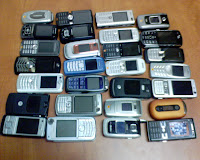
P.S. - The photo above was taken in GamearraY's offices... These are just some of the handsets we have... So it's cool to get the newest gadgets all the time, but every such "gadget" comes with the intent of giving our developers a hard time in the porting process...

Wednesday, July 18, 2007

Facebook vs. LinkedIn

One of the hottest trends today is the migration of business people from LinkedIn to Facebook. For years LinkedIn was THE site for professional networking with no serious competition. But it seems that this situation changed and more and more users open profiles in the new and improved Facebook.

Up until recently Facebook was recognized as a personal networking site, and you would connect with your actual friends, and not with your professional contacts. Furthermore, it was restricted for people with an .edu email (Meaning only graduates of American educational institutes could use it).

A few months back, Facebook changed its policy and opened up for people from all around the world. It also announced an open API through which developers can easily create Facebook applications. This caused many people to open a Facebook account, and as more and more created it - the professional networks formed naturally.

For example, I opened my Facebook account just to experience their interface and API first hand, but before I knew it, I received requests from several colleagues... And now my network there contains some people that are not on my LinkedIn network...

I saw several posts in other blogs of people announcing they will cease to update their LinkedIn profile, and move to Facebook only. For example, Jeff Pulver the VoIP prince (who frequents Israel), wrote that in his blog. Paul Walsh wrote a similar post on his blog (and also a funny story about a friend being dumped by his girlfriend on Facebook...)

And since this is a mobile blog, we can't neglect the mobile aspect in which Facebook seems to be a bit ahead over other social networks: Facebook has a great mobile interface that allows viewing profiles via WAP, uploading photos, sending and receiving SMS notifications and much more.

One annoying thing in Facebook is that they allow those vibrating/flashing/blinking advertising saying that I am the 999,999 visitor (again?...) - it really bothers the eye, and I think that they should have a more strict policy on ads.

So for now, I am still not abandoning LinkedIn, since it served me well so far, but this might change if in a few weeks my Facebook network will outgrow my LinkedIn one. So if you want me to leave LinkedIn, look me up on Facebook...

Friday, July 13, 2007

WiFi / VoIP Wars: Part II

My latest post about the WiFi calls revolution was published in Israel's leading business magazine, TheMarker (Hebrew), and was also syndicated later to Haaretz, one of the leading daily papers here.

This obviously generated a lot of comments from readers on the various sites, and also some from my personal colleagues. So I am going to address a few of those here, but in any case it can clearly be seen that this subject interests a lot of people from across the value chain (including the end consumers...) . Here are the 3 major comments/questions:

1. VoIP subscription - Some noted that calls are not entirely free, since if you want to reach an actual landline/mobile you have to pay to the VoIP provider (Same as with SkypeOut). While that's true for now, think about what happens when most people have a WiFi-enabled phone: We will all be available at least some of the time with our VoIP presence, so everyone can call their friends inside the VoIP network without needing the operators' network (or the PSTN). In that "world" the balance between pure VoIP calls, mixed VoIP/mobile and pure mobile depends on the areas WiFi covers.

2. Quality of service - Some people who use Fring/Truphone said that the current quality of service can be low and they experienced all of the problems new voice services have: poor voice quality, hangups etc. So most still prefer to use regular mobile calls, even if they are more expensive. It's good to get this feedback, however they also agreed that in the long term probably these problems will go away, in the same way we saw Skype improving.

3. WiMAX - Some people asked why I didn't address WiMAX. First off, it should be clear that WiMAX is also a major threat (or opportunity...) to the operators, and in fact it's an extension to the same threat WiFi poses. Anyway, I preferred to focus on WiFi since devices are already in consumers' hands with the relevant software deployed and the infrastructure is here and now. Though several WiMAX networks are already deployed, the full power of WiMAX is still ahead of us (But closer than we think).

That's all for now, I am sure we will hear a lot about this subject. After publishing the post, I also saw that there's quite a "war" in the UK over this issue. Things are about to get interesting...

P.S. - Thanks goes to Guy Grimland who was bugging me for a while to submit an article to TheMarker... Guy is TheMarker's hitech reporter who also covers the Israeli gaming industry and gives it the attention it needs.